

Hey Finance Engineers,
This week a CFO in my feed posted he’s hiring someone with the exact title of this newsletter.
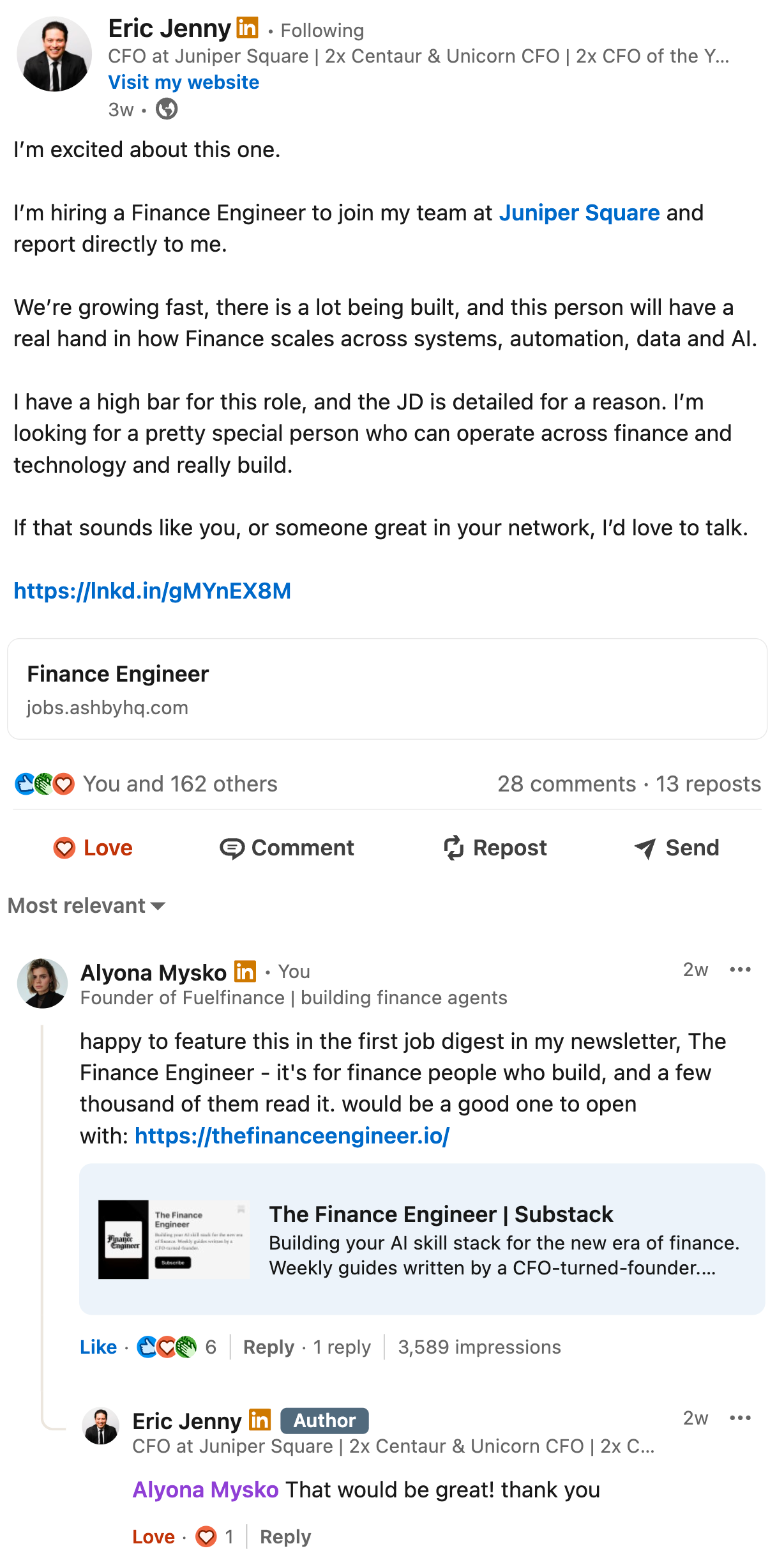
Redesign every finance process, build the automation that runs it, teach the team to do the same. Up to $240K, reporting directly to the CFO.
When I saw it, I was amazed at the opportunities you can have in finance right now if you’re willing to learn AI.
But what I hear from the market is different.
I added a routine to my week: one interview a day with a finance leader, about how they use AI, whether they do at all, and what they make of the agentic finance function. Thank you to everyone who signed up. I’m taking it through the whole of Q4, so if you want to chat, here’s the form and I’ll reach out.
And the thing I hear most on those calls, and from the finance people I’m hiring myself, is fear.
Not the skepticism from the start of the year, when people were still arguing about whether the models could do accounting. It’s past that.
It’s fear of being replaced by the agents, and it’s paralyzing. People aren’t building because they’re scared of what building proves.
I won’t make it softer than it is. The role is changing whether you change with it or not. But I also think this is the best moment to be in finance in my lifetime. Bigger than any tooling shift before it. Bigger than the industrial revolution.
So this is the first job digest you’ll see in TFE.
I went through a hundred finance roles to find the five I think are most interesting for someone reading this newsletter.
They’re at the end. And if you’re not looking, here are the skills that make you the person those companies are describing. Future-proof, if that word still means anything.
Let’s go.
The 5 skills you need to be an Anthropic-level finance engineer
Reading the postings, I kept a list of what they ask for. Then I crossed out the things that are table stakes now, Python (you don’t need to know it to code, by the way), a specific API or MCP, and kept what separates a finance engineer from a finance person with a Claude subscription.
1/ You need to know how to vibe code.
Finance is a portfolio career now: what you’ve built matters more than where you’ve worked.
You need to move past Claude chat, and even past Cowork. Learn what an MCP is, what an API is, how to open Claude Code and get a working tool out of it.
Not to become an engineer. To stop being blocked by the absence of one.
The postings say it different ways, but every one of them wants proof: something you built, that other people use, with a URL. Not a prototype on your laptop. The fastest way to have that is to build something from my archive on your own data. Next interview, that’s your answer to “what have you built.”
Where to start: When to use Claude Code vs Cowork for finance tasks.
2/ You need to know how to build agentic workflows with a human in the loop.
Every posting that mentions AI automation mentions governance in the same breath: auditability, controls, a person at the gate. Companies aren’t hiring the person who makes the workflow run. They’re hiring the person who decides where it stops.
That means knowing the architecture: what tasks are deterministic and what are judgments, how to measure the accuracy of AI output, how to make AI proactively flag when something is wrong. Governance moved from the compliance department into the finance engineer’s job description.
Where to start: the human-in-the-loop architecture I put in everything I build.
3/ You need to know how to work with data and context.
This is the skill I’d rank hardest and most valuable. The finance engineer doesn’t wait for data engineering to hand over a clean table. They define which system’s revenue wins, what a customer is, how the cost centers map, and they build the warehouse layer that makes it true.
And then the part most people miss: context. Not just data, but how the business works, written down so agents can read it. KPI definitions, materiality thresholds, accounting policy, the guardrails. And a mechanism to keep it current, because context that was true in June is a liability in September. Whoever owns the context layer owns the finance function’s memory.
Where to start: Write your finance context file with me (Claude skill inside)
4/ You know what GitHub is, and you have your own repo.
Version control is painful to learn and impossible to skip. Most of these postings require it, and the reason is simple: if you build things, you need to do it properly. Versioned, reviewed, owned. Not a folder of skill files on a laptop that leaves when you do.
It’s also your portfolio. A repo of validated skills, each with an owner and a status, is the best resume in finance right now. And it’s the only way a team of builders doesn’t turn into a mess by week two.
Where to start: How to set up GitHub for your finance department
5/ You need to be the example, and teach others to be an AI-native finance department.
What it means in practice: map the workflows with the specific people on your team. Sit with each one. See what agents can take, and where that person’s judgment is the thing that can’t be replaced.
Then build it with them, not for them.
And create the knowledge-sharing habit. A channel, a weekly show-and-tell, a shared repo. Not everyone was born AI-native. Not even your smartest teammate.
Where to start: bring your team to my live workshop on the AI-native finance function on September 30.
We launch our product there too, but most of it is about what an AI-native finance department looks like in practice.
What I’d tell the person who’s scared
The fear is rational.
The role your title describes is being rebuilt underneath you.
But look at what these companies are paying for: not someone who competes with the agents, someone who directs them.
Every skill on the list is about judgment, design, and teaching. The agents do the matching. You decide what gets matched, where it stops, and who checks it.
So instead of being depressed that the job isn’t what it was, learn it.
Nobody was a finance engineer three years ago. Now it’s a job you can learn and be in the top 5% of the market.
This week’s roles
Juniper Square - Finance Engineer · US remote · $190K-$240K
Reports to the CFO, redesigns every finance process, and asks you to bring a URL, not a resume.
Mercor - Agentic Finance Engineer · San Francisco, on-site · $175K-$250K
Their first one, at a $10B company. Blank page, your architecture, your agents.
Ironclad - Senior Finance Systems & AI Engineer · San Francisco, hybrid · $156K-$195K
Automate the close with the Controller, then build the agents that keep it automated. SOX-proof, of course.
Subscribe (and stay for the ride)
If you made it this far, you’re one of us. Subscribe for the weekly drop and these specials.
→ If you’re a vendor and you genuinely have something to offer this audience, fill in this form.
That’s it for today.
Tell me in the subscriber chat what you think.

And if you’re hiring a finance engineer for your team, let me know in the comments and I’ll add your role to the next digest.
— Alyona