

Hey Finance Engineers,
Every single webinar, someone asks me the same question: “When do I use Cowork, and when do I need Claude Code?”
It comes up so often that I decided this issue needs to be here.
In the next 7 minutes you’ll know exactly when to reach for each one, what’s running underneath both, and how to start with Claude Code without feeling like you wandered into the engineering department.
Chances are, you’re one of two types. I see it in every interview I run with finance professionals: on one end, the pros deep into Claude Code, MCP, connectors, APIs, building complex tools that run their whole close. On the other end, people stuck in chat and Cowork, afraid to start with Claude Code. And almost nobody in the middle.
If you’re sticking to Chat like Max Verstappen to Red Bull (yeah, he extended the contract through 2030 - George Russell can finally breathe easily), this issue is for you.
Let’s go.
How it all started
Claude Code was pretty much built by accident. Boris Cherny spent almost seven years at Meta as a Principal Engineer - leading server architecture at Instagram and code quality across Meta - then joined Anthropic in September 2024.
To get familiar with the API, he built a tiny terminal app. Then he gave it a bash tool and asked what music he was listening to. The model wrote a little AppleScript to check his Mac and answered. That was his “feel the AGI” moment. He gave the thing access to files, shared it with his team - and 50% of Anthropic engineering was using it within five days. It launched publicly in February 2025.
That accidental terminal app now runs at over $2.5 billion in annualized revenue.
I try to watch all of Boris’s interviews. On Lenny’s podcast it turned out he’s Ukrainian, just like me - born in Ukraine, emigrated to the US in 1995. Small thing, but it made me like the tool even more.
Then came Cowork. Anthropic noticed that non-engineers were reaching for Claude Code - people were analyzing MRIs and recovering wedding photos off corrupted drives with a coding tool. So the team built Cowork in 10 days, largely using Claude Code itself to build it, and launched it in January 2026. Anthropic’s own launch line: “Claude Code for the rest of your work.”
And the usage proved the point: Anthropic reported that more than 90% of Cowork tasks weren’t software development. Their own examples of what people do in it: “reconciling the quarter’s spend and drafting the variance memo, turning a folder of contracts into a renewals tracker with the risks flagged.” Sound familiar, right?
How both work technically
Cowork does the work with you: the task happens inside the conversation, and when you’re happy you take the result.
Claude Code builds a thing you need: it writes real code and scripts, and the result exists after you close the window, with its memory kept in a file called CLAUDE.md.
Cowork runs on the same agentic engine as Claude Code - the same harness, the same plan-act-check loop underneath. Same engine, different cockpit. One is a terminal you steer directly; the other is a desktop app that hands you the finished lap.
Why finance engineers need both
I classify every finance task into one of two buckets.
1/ Deterministic tasks. Same steps, same rules, every time. Matching two files. Rule-based reclassification. Reconciling a known format. There’s a right answer and a fixed way to get there.
2/ Judgment tasks. You give a goal, and something has to work out how to reach it. Variance analysis is the classic one - you don’t want the number, you want the WHY, and the why is different every month.
A pit crew knows this instinctively. A pit stop is deterministic: same moves every time, practiced until it’s muscle memory - McLaren once turned a car around in 1.80 seconds, and it’s the same routine every single stop.
A pit wall strategy call is judgment: box now or stay out depends on the weather, the tyres, the safety car, the guy behind you. Completely different kind of decision.
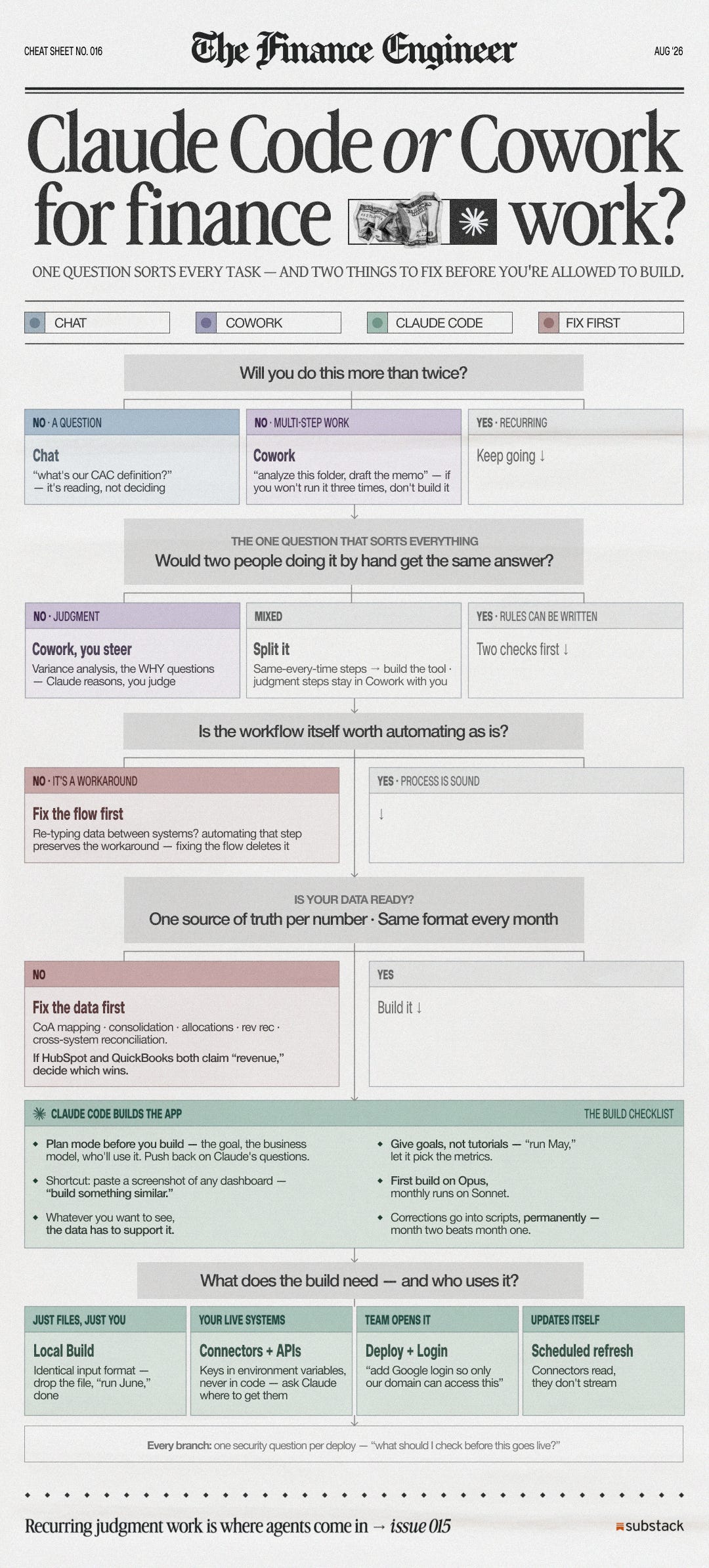
To make this easier, you can ask: would two different people doing this task by hand produce the same answer?
→ Yes → it’s deterministic → Claude Code builds the tool once, and it runs the same forever.
→ No → it’s judgment → Cowork for a one-off. An agent with a human on the output for anything recurring.
What Code wins at
First, context. After you’ve worked in a project folder for a while, you stop attaching things. It knows your project - the files, the structure, the definitions. In chat and Cowork you’re forever re-uploading and re-explaining. One Head of Finance told me after her first month in a Claude Code project: “it feels like it understands me so much better.” That’s not magic, that’s the folder.
Second, stability. Code writes real scripts behind the build. Your logic gets pinned into those scripts instead of being re-improvised on every run. Same inputs, same outputs. In finance, that’s the entire point.
Third, tokens. For the same recurring job, Code eats fewer tokens than chat or Cowork, because you pay for the thinking once - at build time. After that you’re running a script, not re-reasoning from scratch every month.
Every Claude Code build ends up with the same folder structure:
your-build/
  inputs/     ← the raw files you drop in
  outputs/    ← what it produces
  scripts/    ← the logic
  CLAUDE.md   ← the memory
  readme      ← the human explanation
This is how good engineering is organized. Two files matter most. Scripts is where your feedback becomes permanent: in chat, your corrections are a conversation that disappears; in Code, your corrections are infrastructure. And CLAUDE.md is why month two is better than month one - every rule you taught it is still there.
How to start with Claude Code
1/ Install Python. The one prerequisite. Open Claude and type “do I have Python installed, and if not, walk me through it.”
2/ Use Plan mode. The most important step of everything. Before Claude Code builds, describe what you want - the business model, who’s going to use it, what decisions it should support. Claude asks questions. Push back on them. Two shortcuts I love: paste a screenshot of any dashboard and say “build something similar,” or connect your meeting notes and say “build what we discussed Tuesday.” One rule that saves you every time: whatever you want to see, the data has to support it. Want a customer-level drill-down? You need customer-level data in the file.
3/ Data prep. Clean inputs, consistent structure. Most builds succeed or fail here, before anything gets built. We have a separate data-prep guide if you want the deep version.
4/ Give it goals, not tutorials. Here’s the story I tell everyone. We dropped a GL, a balance sheet, targets, and pipeline into a folder and typed “run May.” No instructions on which metrics to calculate. Claude read the data, understood it was a SaaS business, and picked the metrics itself. Then we corrected a few things - and those corrections became permanent rules. The corrections are the work.
5/ Connectors, APIs, deployment. When you’re ready to go past files: an API is how two systems talk to each other directly. Your keys go in environment variables, never in the code itself - and if you don’t know where to get an API key, ask Claude, it walks you through the screens. Vercel is where the build becomes a page your team can open. One command, and a free account is enough to start.
6/ Keep the input format identical every month. Same structure, same columns. Drop the new file in, say “run June,” done. Freeze the format like a setup sheet and the whole thing just runs.
7/ Put a login on anything with real numbers. One sentence: “add Google login so only people from our domain can access this.” And ask Claude a security question on every deploy: “what should I check before this goes live?”
When to stay in chat or Cowork
Three cases where building in Claude Code is the wrong move.
1/ One-off analysis stays in Cowork. Building a tool for something you’ll do once is engineering theater. The rule: if you won’t run it three times, don’t build it.
2/ When ten data sources fight about the truth. One folder of clean exports works beautifully. Ten data sources with conflicting definitions of revenue does not. If HubSpot and QuickBooks both claim “revenue” and there’s no rule for which one wins, you get confident answers built on the wrong number - worse than no answer. You need normalization first: a data warehouse, or explicit source-of-truth rules. Fix the truth before you automate the math.
3/ Live data isn’t a connector feature. Connectors let Claude READ your sources. They are not live pipelines. If you want a dashboard that updates itself, deploy it properly or schedule a refresh. Ask Claude directly: “how do I structure my data inputs so this updates live?”
Subscribe (and stay for the ride)
If you made it this far, you’re one of us. Subscribe for the weekly drop and these specials.
Sixteen issues in: a rev rec agent, a 9-agent controller workflow that took our close review from 3 days to 2 hours, the skill that builds all our other skills, and more every week.
Pro subscribers get everything: every skill file and prompt as ready-to-drop-in .md files, the deeper tutorials, and the subscriber chat - where I answer questions.
→ If you’re a vendor and you genuinely have something to offer this audience, email me at team@thefinanceengineer.io or DM me on LinkedIn.
So, which one do you use?
→ One-off question or analysis → chat or Cowork
→ Recurring task, same rules every time → Claude Code builds you an app
→ Recurring task that needs judgment → an agent with a human on the output
→ Editing an email → chat. It’s still great at that, and you don’t need a factory to write two sentences.
Same engine, different cockpit. Once you stop thinking of Claude Code as “the engineer thing” and start thinking of it as the car you build once and drive every month, the whole choice gets simple.
That’s it for today.
What’s the one recurring task you’re going to move out of chat and build properly this month? Tell me in the subscriber chat - I read every one.

— Alyona
I was building a product profitability in the chat. Moving it out at the moment! Thanks for sharing
The "ten data sources fight about the truth" point deserves its own issue. Most failed builds I hear about didn't go wrong in the script, but broke because nobody decided which system's revenue number wins.