

We all live in the undefined
I was on a morning run with Haku, my husky, listening to My First Million. The episode with Amjad Masad, founder of Replit. Haku was sniffing every tree like usual. I was half-listening like usual.
Then Amjad said something I haven’t been able to shake.
He was talking about the singularity.
The concept comes from astrophysics. A singularity is what happens at the center of a black hole. Past the event horizon, the math breaks. The equations that describe everything else in the universe just stop working. Gravity, time, distance. All of it goes weird.
You can’t predict what happens next, because the rules you’ve been using no longer apply.
The future stops being uncertain and becomes literally undefined. There are no formulas for it. It’s the universe shrugging at you.
At this point, stay with me: this is a finance newsletter, I promise.
Vernor Vinge, an early computer scientist and sci-fi writer, borrowed this idea in the ‘90s and applied it to technology. His argument: at some point, AI advances fast enough that the pace of change itself becomes unpredictable. Fast, then faster, then accelerating. The second derivative goes exponential.
Once you’re past that point, you can’t project forward anymore. The planning tools we use to think about the future stop being useful. Five-year strategy decks become creative writing.
Amjad’s point was: we’re there. Right now.
Honestly, when you look around, it’s hard to argue.
In 2022, GPT-4 dropped and felt like a revolution. Before that, we got a major model every two years. Now we get one every few weeks. Sometimes every day. Sometimes I check X in the morning and someone has built a thing I didn’t know was possible by lunch.
Each new model unlocks capabilities that haven’t been productized yet. A pile of potential energy just sitting there, waiting for someone to figure out what to build with it.
I’ve been a CFO. I’m now a founder. I’ve pivoted our strategy three times in the last month. Three times. In one month. The ground just won’t stop moving.
Nobody knows where this goes. But the people who figure things out in undefined moments are the ones who win the next decade.
For finance, I want to call them Finance Engineers.
How we vibecoded so hard we accidentally became engineers
A few years ago, a company called Clay (yes, that Clay) had this problem. Their go-to-market team had people doing something that didn’t fit any existing title. They were too technical to be SDRs. Too sales-brained to be engineers. This weird hybrid - data, revenue, automation - all in one person.
So Clay made up a name: GTM Engineer.
Today, 100+ GTM Engineer roles get posted every month. Every growing startup needs one. A job title that literally didn’t exist became a career path - because one company said “this is a real thing” and built the infrastructure around it.
There’s something similar happening in finance.
In 2025, Andrej Karpathy - co-founder of OpenAI, former head of AI at Tesla, and now a part of Anthropic, probably one of the five smartest people working on AI right now - wrote a post that changed how an entire industry thinks about building software.
He described a new way of creating things. You don’t write code. You describe what you want - in plain English. The AI writes the code.
He called it vibe coding.
This blew up in engineering. And then (because apparently finance people can’t resist a good tool) it jumped the fence.
I’ve been vibe coding for months now. I built a cash flow forecasting tool. I spend my weekends testing the new finance agents from Anthropic (more on this + a full tutorial in the next issue). I went to one of Rillet’s vibe coding workshops and watched a CFO build a pricing calculator from scratch in under 20 minutes with Claude Code.
Aesha, a financial manager on my team at Fuelfinance, built an interactive dashboard that pulls live data and visualizes it dynamically. She’s not an engineer. She just opened the tool and started building.
This is happening everywhere. Finance people (FP&A managers, controllers, heads of finance, CFOs) are building software.
They didn’t plan to become engineers.
They vibecoded so hard they accidentally became one.
The skillset and the mindset of a finance engineer
So who are these people?
Let’s get specific. Take a Head of Finance at a $15M company. Series A, maybe early Series B. Small team - maybe it’s them and two analysts. Maybe it’s just them.
The core finance skills didn’t go away. AI doesn’t replace any of that, it amplifies it. Without the foundation, you’re just someone with Claude and a very, very dangerous amount of confidence (in finance, 99% right is still wrong).
But the layer on top is new. And it’s expanding every month.
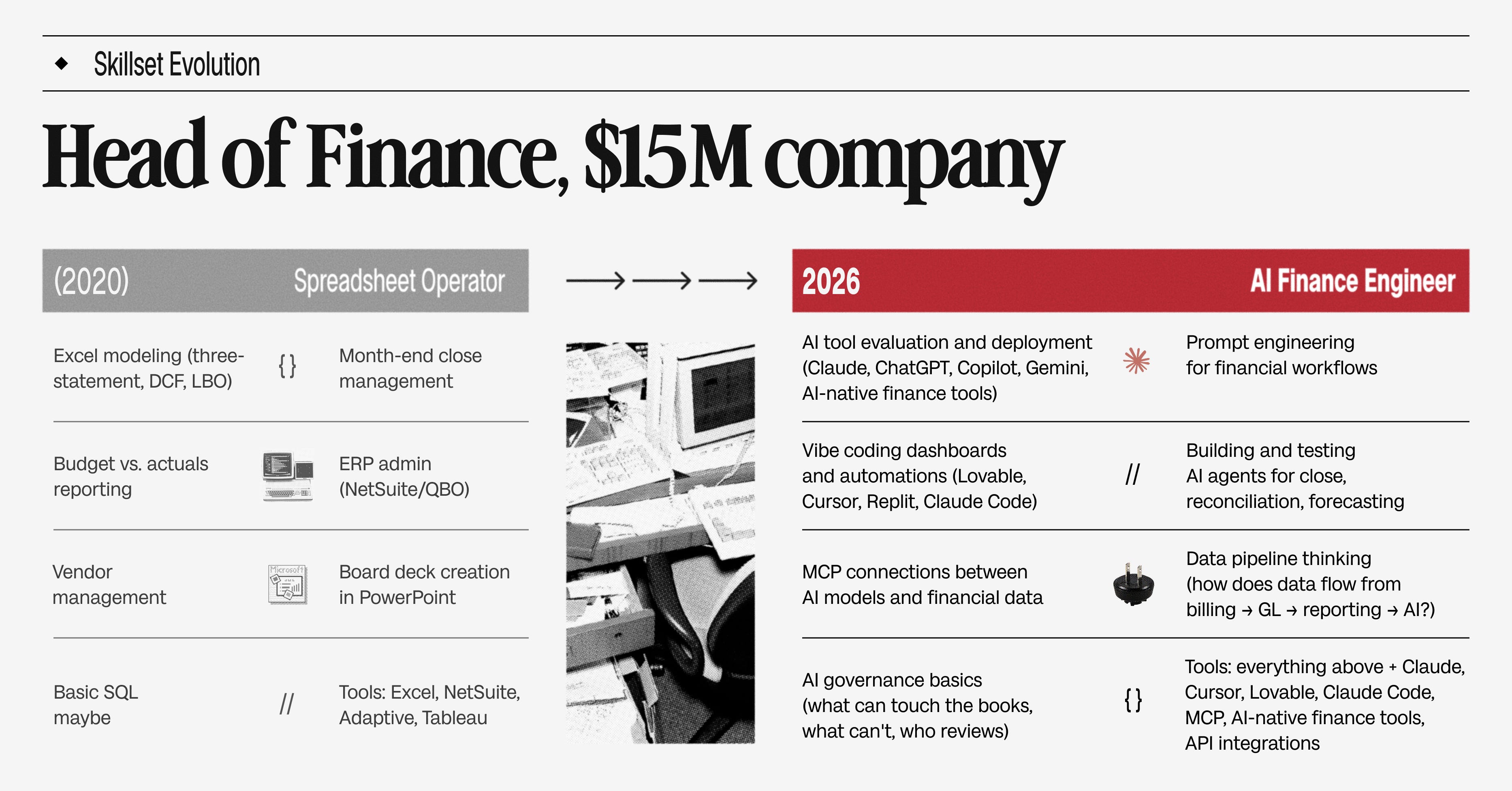
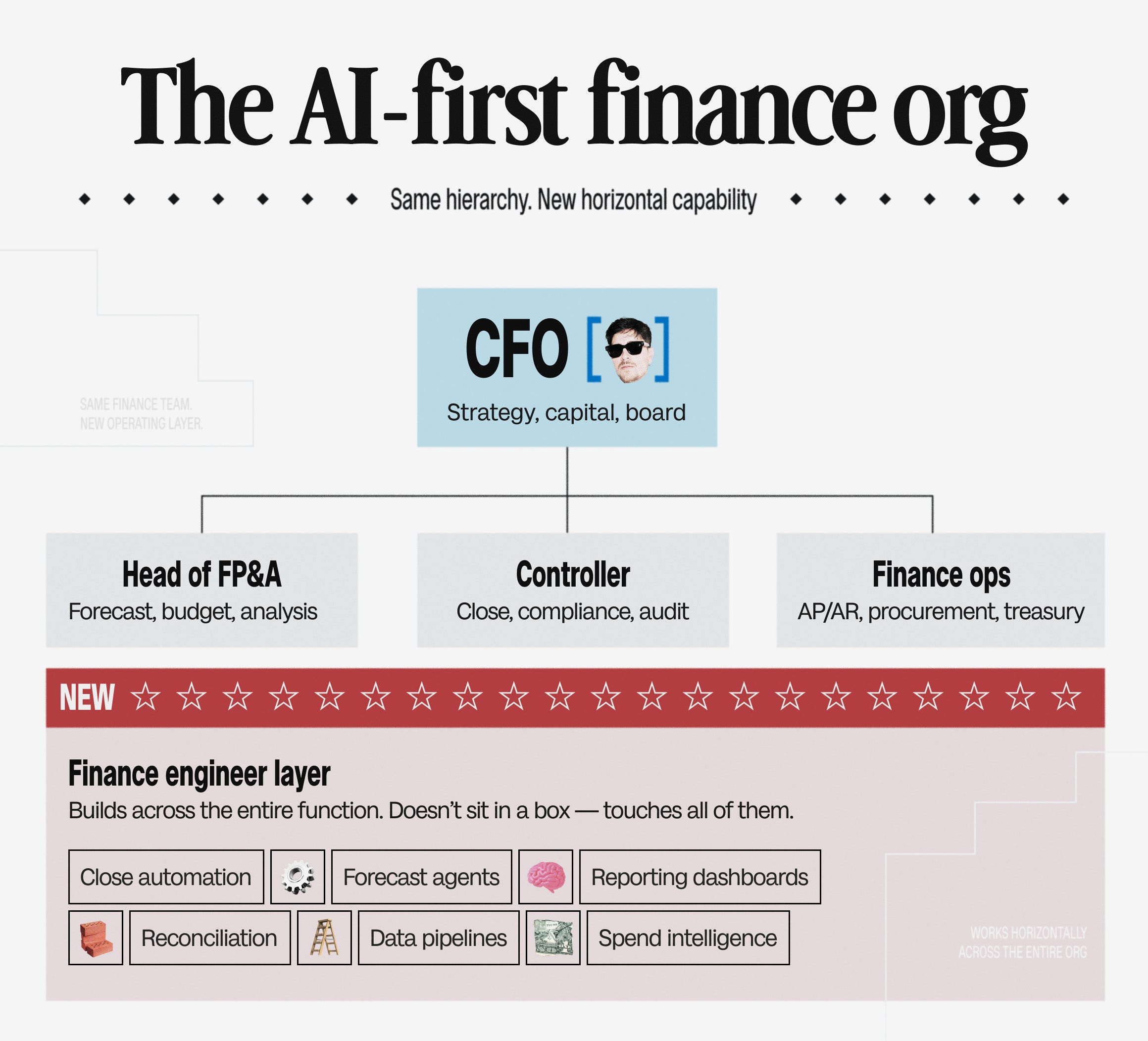
Here’s what I’ve come to believe: finance engineering isn’t a job title. It’s a skill layer that’s being added to every finance role. The Controller still closes the books, but now they automate the close. The FP&A Manager still forecasts, but now they vibe code the dashboard. The Head of Finance still runs the function, but now they build the systems that run it. Same people. Same titles. Fundamentally new capabilities. And nobody’s teaching it, which is kind of why we’re all here.
And here’s the thing nobody’s saying (well, maybe only on reddit) - this transition isn’t always easy.
Sometimes your CEO is pushing AI on the team while you haven’t even gotten the data right yet. You’re being told to “implement AI in finance” while your chart of accounts is a mess and your ERP hasn’t been updated properly. Cool. Sure. Let me just connect Claude to our garbage data and see what hallucinations we get.
Sometimes you’re doing this out of pure fear. You think “how fu*ked are we?” when someone fed AI two budgets and got back a complete variance analysis that looked like a real analyst wrote it.
And you thought: wait. Is that my job? Can it do my job? Should I be scared right now??
And sometimes - honestly? Sometimes you open a vibe coding tool for the first time and build something in 30 minutes that would’ve taken you two weeks, and your brain just... short-circuits. You can’t have another reaction. It’s like seeing a magic trick except it’s real and you did it and now you don’t know what your job even is anymore.
All of these reactions are valid. All of them are happening simultaneously in finance teams everywhere.
Here’s what I think is true:
I don’t know exactly where this goes. I really don’t. Anyone who says they have a five-year roadmap for AI in corporate finance is selling you something.
But I’m pretty sure about one thing: if you don’t learn this new skillset - whatever we end up calling it - you can be replaced by someone who did.
So stay for the ride :)
Building your skill stack for the new era of finance
So here’s what this newsletter actually is.
My team and I are personally testing dozens of tools and workflows every week to figure out what actually works for the new era of finance.
My dear CFO and head-of-finance friends (the ones I’d genuinely call finance engineers) are testing too. And they wanna share.
Right now, the newsletter runs on two formats:
→ My guides on engineering stuff in finance. When I automate something, I’ll show you the prompts, the setup, the output, and what went wrong. When I test AI agents on our close, you’ll see the screenshots. This is a build log, not a thought piece.
→ My finance friends sharing what they built - step by step, tool by tool. Maybe we’ll be eating bagels or having a filter coffee on a lunch break while we prepare these.
You’ll also find thoughts beyond the finance role. Going from CFO to founder building AI taught me things I never would’ve learned inside the department. I’ll share those too - between all the practical stuff this newsletter is truly about.
The founding partners
The founding partners of The Finance Engineer are the people and communities who shaped me, both as a finance person and as a founder.
→ Hampton
Founded by Sam Parr, who built and sold The Hustle newsletter to HubSpot. A lot of what I know about writing on the internet, I learned from Sam directly.
Hampton is Sam’s founders community I’ve been a member of, and a huge part of why I’ve grown as a founder over the last couple of years. One day I hope The Finance Engineer becomes for finance leaders what Hampton is for founders. If you’re a founder doing $3M+ a year, Hampton is the room you want to be in.
→ FIF Collective
Run by Megan Curtin McKenna, FIF is the best women-in-finance community I’ve ever been part of, and one of the most generous, sharp networks of finance leaders I know.
Megan has built something rare. Whenever I’m testing something new or building content, FIF gets to see it first and give honest feedback. If you’re a woman in finance, I cannot recommend joining strongly enough.
→ Light ERP
Light is an AI accounting platform. AR, AP, expenses, bookkeeping, and reporting, running automatically across every entity. It’s all-in-one, built for fast-moving SaaS companies that never needed a heavy ERP. I’m watching this space closely, and they’re building it the way I’d want it built if I were starting an accounting platform today. They’re also the platform Lovable runs on. Worth a look if you’re rethinking your stack.
→ Spendesk
Spendesk is one of the most established spend management platforms in finance, and the team behind CFO Connect, one of the largest communities of finance leaders. What I’ve always respected about them is how seriously they take the finance community itself. The events, the content, the actual investment in helping CFOs become better operators. Not many vendors do this.
Grateful to all four of them for backing this early.
Subscribe (and stay for the ride)
If you made it this far, subscribe for the weekly drop.
I’ll be sharing every prompt, every screenshot, every mistake I make. Plus interviews with finance engineers I learn from every week.
You’ll get deeper tutorials, behind-the-scenes builds, and soon - access to a private chat with other finance engineers. Where we share questions, prompts, .md files, and what’s working in our own workflows.
→ If you’re a vendor and you genuinely have something to offer this audience, email me at team@thefinanceengineer.io, or DM me on LinkedIn.
You’re not behind. You’re early.
Thank you for being here. Truly.
— Alyona
AI is turning finance into a build function, which is inconvenient for anyone still worshipping the spreadsheet.
https://paretoinvestor.substack.com/p/how-chatgpt-beat-market-ai-investing-methodology
Hey! I'm Shatakshi. 👋
I'm building Finance School, where I break down topics in finance, business, economics, and corporate reporting into simple, practical articles. As a CA student, I'm constantly learning, researching, and sharing what I discover along the way.
If these topics interest you, I'd genuinely love for you to stop by. Your feedback, questions, or even a different perspective would mean a lot.
Thanks for reading! 😊