

Hey Finance Engineers,
In this newsletter we build the skill set and the mindset of a finance engineer, the new layer landing on every job in finance.
Today’s a short one, more mindset than how-to. But first, someone sent me this and I haven’t recovered:
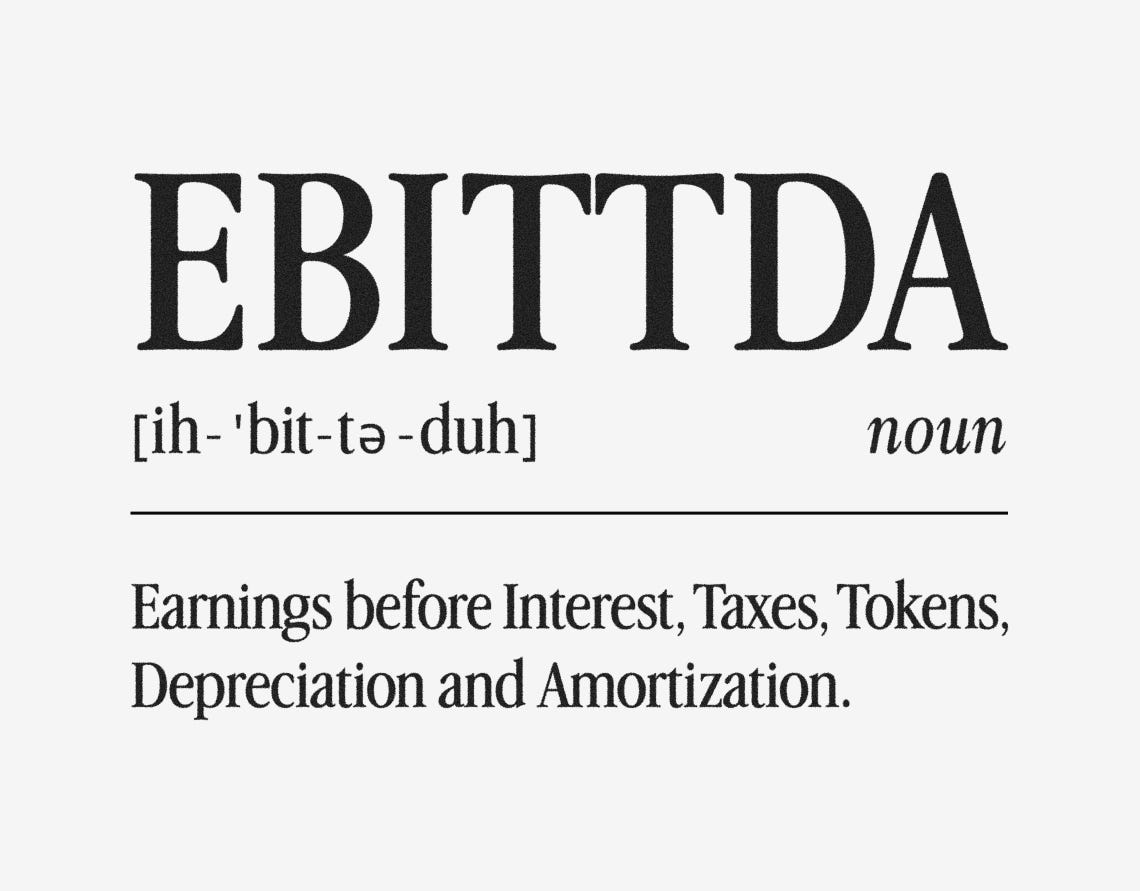
Earlier this year, an AI consultant told Axios that one of their clients spent $500 million on Claude in a single month.
They gave every employee a Claude license and never set a usage limit. People ran agents, agents ran agents, and an agentic workflow eats roughly a thousand times the tokens of a normal chat. Nobody was watching the meter. The bill just arrived.
The company stayed anonymous. The only mercy in the story. But it wasn’t a single accident. Uber burned through its 2026 Claude Code budget in 4 months. Microsoft started killing internal Claude licenses when engineers hit two grand a month each. AI bills are up 320% while the price per token has dropped 98% since 2022.
Tokens got 98% cheaper. The bills tripled.
Turns out, it’s a behavior problem.
Tokenmaxxing → efficiency-maxxing
And this behavior has a name. Tokenmaxxing. For about 2 years it was the whole industry’s mood, rewarded internally with, I’m sorry, actual leaderboards.
To drive adoption, companies built dashboards ranking employees by how many tokens they burned. Whoever used the most AI won.
Take a second with that. Grown adults with finance functions decided the path to the future was a scoreboard for who could spend the most company money.
Amazon employees reportedly started asking Claude to check the weather, just to climb. Meta’s leaderboard leaked and the reigning “Token Legend” had burned 281 billion tokens in a single month. Amazon eventually pulled the plug, and an executive had to send the most 2026 sentence ever committed to a company-wide email: “Please don’t use AI just for the sake of using AI.”
The president of AI at Replit called it “very dystopian.” His comparison was leaving every light in the house on and not caring about the bill. Generous, honestly. The lights at least do something.
When a measure becomes a target, it stops being a good measure. Reward people for burning tokens, and token burn tells you only one thing: who’s best at burning tokens.
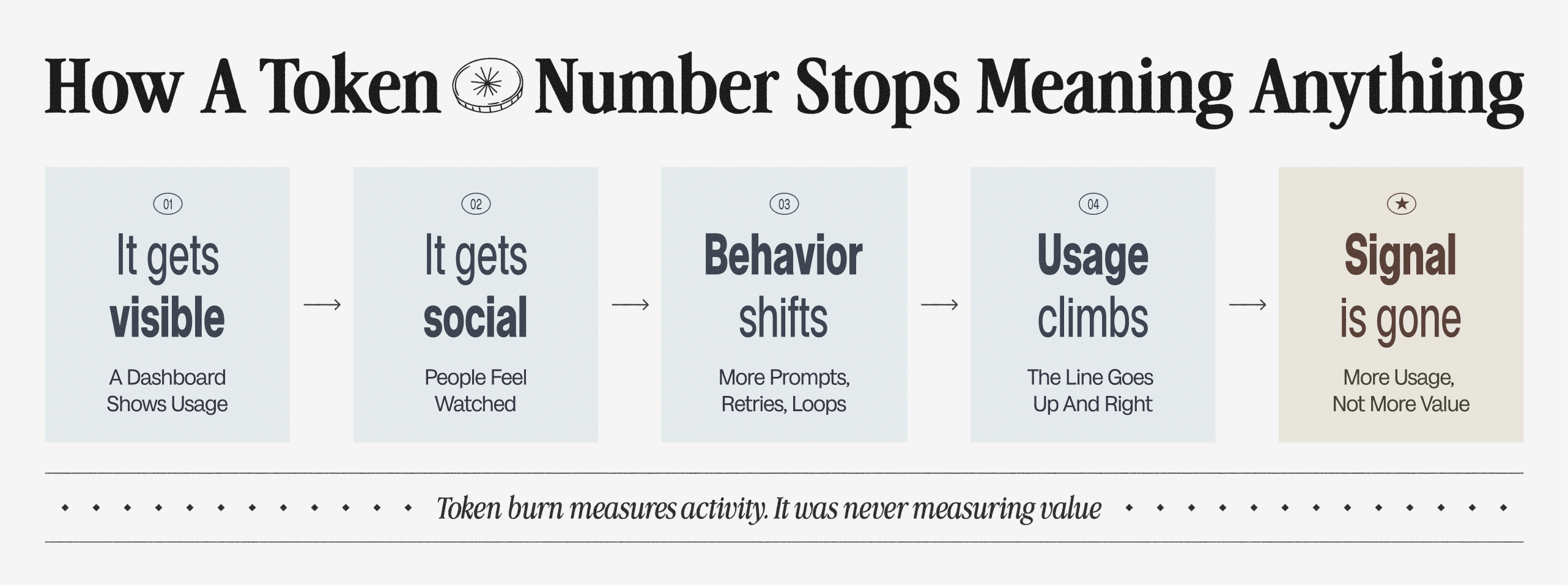
We did a softer version of this ourselves.
One of our monthly company decks at FUEL had a slide. Token usage up 350% month over month. My first reaction was honest and slightly embarrassing: oh, wonderful, adoption is taking off.
I felt good about that slide for ten seconds. Then a smaller, more annoying thought arrived. What did we actually get?
Nothing. The line went up and to the right, it looked like progress, it had the shape of progress, and it told me absolutely nothing about whether we were a better finance team or just a pricier one. The most attractive meaningless chart in the deck.
Token burn tells you who’s spending. It never tells you who’s winning.
Why this is the CFO’s job now
Tracking AI ROI is the most valuable thing a CFO can do for a company in 2026.
I don’t mean cutting AI (we’re the finance engineers here). Making AI mean something.
This is the huge part of having a finance engineer mindset. no matter you’re an analyst, head of finance or a CFO here.
Every other line item in your business needs to have a goal. Marketing has a CAC. R&D has a roadmap. Sales has a quota. AI spend, in most companies, has none of that. Yet.
The polite word for the new era is efficiency. The honest one is accountability. And accountability lands on the person holding the budget.
That’s the role. Not the AI police writing tickets. The only person in the building still asking what all of this is for.
Strategies I’ve seen companies use
A few plays I’ve seen, roughly in order of how much they help.
→ Hard kill switches. Spend ceilings and auto-shutoffs at the agent, workflow, and team level. A runaway agent can rack up a six-figure bill in hours, faster than any monthly review catches it. Uber now caps agentic coding at $1,500 per engineer per month. Set the ceiling before you need it.
→ Banning juniors from AI. A handful of companies don’t give juniors LLM access. Two reasons. They think it slows the learning curve, and unsupervised juniors burn more tokens than seniors without producing better work. At Anthropic, of all places, the biggest token user is the head of tax. Most senior, most expert, pointing the most AI at the most valuable work.
→ Budgets by team, not by person. Individual budgets create the leaderboard problem, every user maximizing their own allocation. Team budgets create collective responsibility. Set the budget by team, alert at 50, 80, and 100%, let the team police itself.
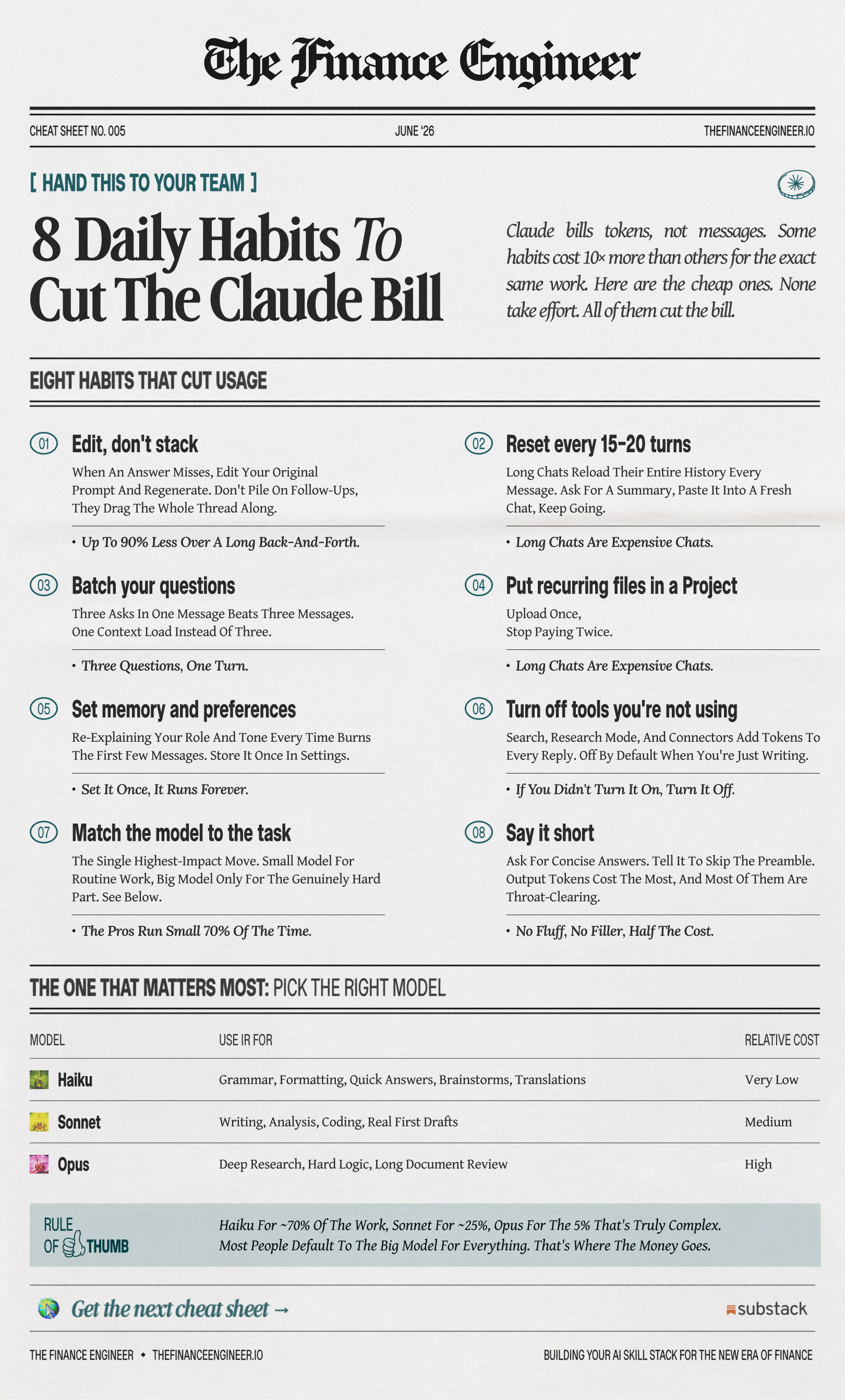
→ Teach the team the cheap habits. Edit the prompt instead of stacking ten follow-ups. Start a fresh chat every 15-20 turns instead of dragging a 30-message history into every question. Small model for grammar and formatting, big model for the actual thinking. None of it is hard. Nobody does it until someone shows them. So I made a one-page cheat sheet. It’s at the bottom. Send it to your team.
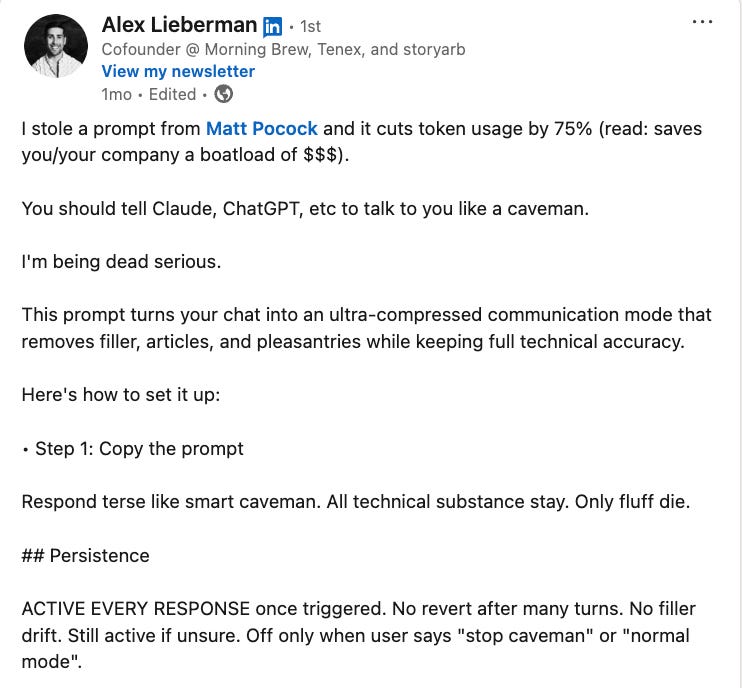
→ The caveman method. A fun trick I learned on LinkedIn. You tell the model to “respond like a caveman.” It looks ridiculous and cuts output tokens close to half on routine work.
→ An AI ROI dashboard. A live view of what your AI spend is producing, broken down by team. Three things I’d put on it:
Cost per task, human vs. AI. What the work cost when a person did it, fully loaded, vs. now. Dollars per finished thing, not tokens.
Hours saved, as capacity. Translate hours into the hire you didn’t make. But never round up to “we don’t need this person.” I’ve automated half our finance work and never once concluded we don’t need our Head of Finance. The honest version is capacity, not replacement.
Real time saved. AI feels instant, two clicks and you’re done. Then 40 minutes checking and fixing it. A dashboard that counts the two clicks and ignores the forty minutes is lying to you the same way the token chart did.
I’ll walk you through building one soon. If you’ve already built one, share what’s on it in the comments.
Your move
Whatever your title, the job of finance department, and of whoever leads it, is to make AI usage mean something for the company.
Start with yourself and your own department. How much do you spend on AI? Which tasks does it actually pay off on? Where does it make more sense to just buy a dedicated tool instead of burning tokens on the same task every week? Then look at your team. How are they spending it?
And before any of that, make sure you’re on the right Claude plan, so you have the admin controls to see and cap all of this in the first place.
So, leaving you with these thoughts today, and coming back soon with the practical one: how to actually build the AI ROI dashboard. Don’t miss it.
I also made a one-page Claude token cheat sheet, the cheap habits that cut a team’s usage up to 70%. Download it, send it to your team, pin it in Slack.
— Alyona
I'm puzzled as to how these organizations are racking up giant bills without realizing it until it's too late. We pay $20/month/user for Standard "team" seats, which have built-in usage limits. Completely predictable and controllable spend. If someone keeps hitting their usage limits, then we either educate them on token efficiency or upgrade them to a $100/month Premium seat. Still completely predictable and controllable. For larger organizations or different use cases, the Enterprise and API plans have spend-limit settings.
Are there really organizations out there who are just giving Anthropic their credit card number and then looking away?