

Hey Finance Engineers,
For a while now, every finance tool has been advertising you a 1-day close.
Then a few weeks ago Sarah Friar (OpenAI CFO) wrote that we’re actually close to something bigger - a continuous close. A close that basically runs itself, updates all the time, and needs minimum human sign-off. Agents and AI are going to do it.
I believe her. But the most important part of a continuous close is the controlling part. That’s what actually takes the time.
And that’s the part we learned how to cut. From 2-3 days of one person’s work → about 2 hours with an agentic workflow. 9 agents. Somewhere between $100-130K a year in controller time, freed.
This is the full internal reference we use ourselves: what each agent does, where every file lives, and the exact formulas behind the scores. You could hand this issue to Claude and start building your own version this week.
Let’s go.
What is the agentic workflow?
To work well, one agent needs to do one thing only - and have its own set of skills and context.
Which is why there can’t be a “controller agent.” Controlling is not one task.
Controlling can be agentic only if it’s a set of agents, each responsible for one task, that run in a fixed sequence and talk to each other. With human gates in between - moments where the workflow physically stops until a human looks and signs off.
The whole system is designed to prevent phantom findings. An agent noticing something isn’t mentioned and concluding it’s missing - without ever counting the actual GL rows. Absence of a mention is not evidence of absence of data. Every check in this workflow runs against the ledger itself, never against a summary of it.
If you’re new to AI or agentic finance, some definitions (skip if you’re a pro):
→ Agent - an AI that doesn’t just answer, it works: reads files, runs its checklist, writes a report.
→ Skill - a file that tells the agent exactly how to do its one job, step by step. The agent’s job description/SOP.
→ Context - the company-specific knowledge the agent reads first: your chart of accounts, your materiality thresholds, your accounting policy.
→ Orchestrator - the agent that runs the other agents. It sequences everything and tracks state, but analyzes nothing itself.
Our controlling workflow: 9 agents, 2 human gates
One fixed sequence, two gates where it stops for you:
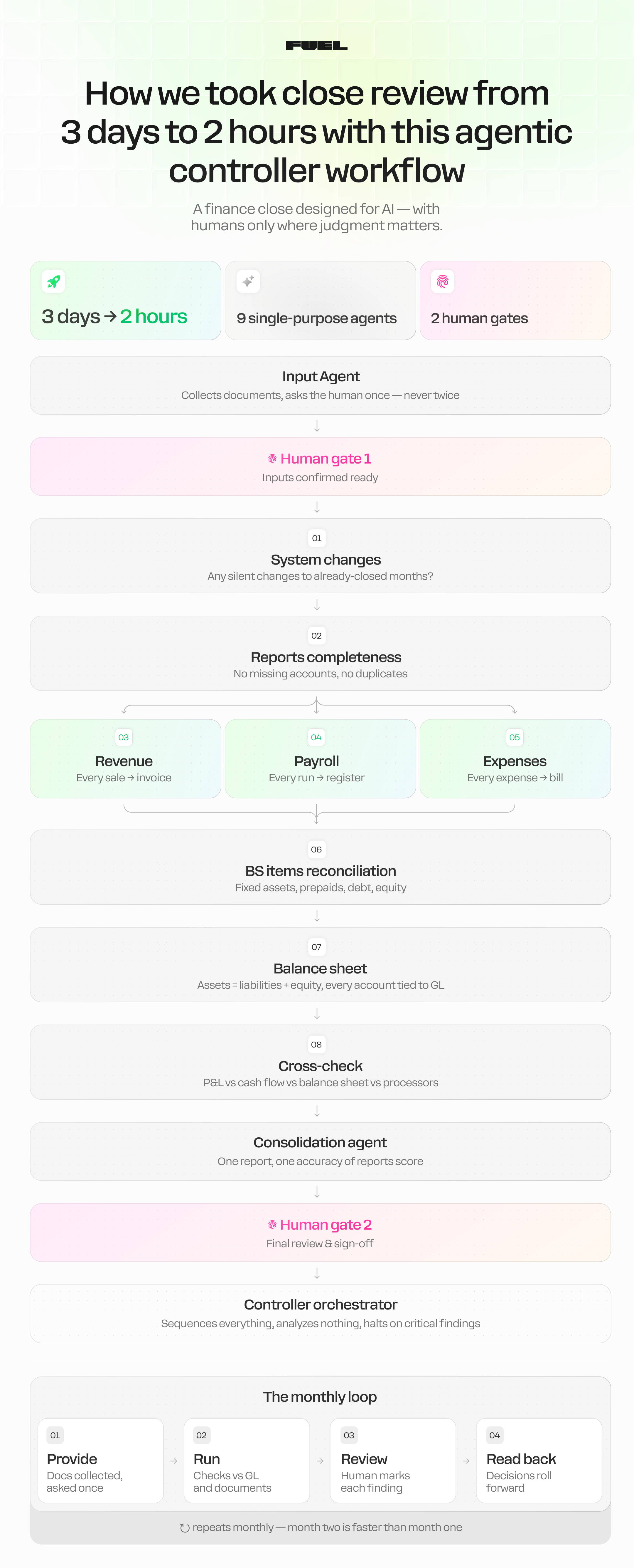
How it runs: you drop the month’s documents into a folder, the Input Agent asks you once for what’s missing, you confirm - Gate 1 - and go do something else.
The agents run the sequence. The Consolidation Agent pulls every finding into one report with one score, and that report waits for you at Gate 2. Your two hours live here, and the workflow does not ship without you.
Underneath it all: the Controller Orchestrator. It sequences everything, analyzes nothing - and halts the run the moment any agent escalates a critical finding.
And if you’d rather have this built for you: this is exactly what my company, Fuelfinance, does for finance teams - an agentic finance operation, launching Sep 29. If you ever want to see it running on your own data, here’s the demo link.