

Hey Finance Engineers,
Let’s talk about the least glamorous days of your month: the ones you spend recognizing revenue.
You know the ritual. Terms out of the contracts. Invoices out of Chargebee. What actually posted to QuickBooks. Did the cash truly land. Match it all line by line, apply the schedule, make the calls - and hope this month’s logic matches last month’s, because nobody wrote last month’s down.
Three systems that have never been introduced, and you in the middle, translating.
Today’s issue is a build log: how a finance person on our team (no engineering background) turned that ritual into an agent, the exact structure so you can copy it, the five questions to encode your own rev rec rules - and a live walkthrough on July 9 where you can watch the full thing tear through a real pipeline.
Let’s go.
Why this is the process worth automating first
Rev rec is the top line of the P&L, and the top line drives valuation - get it wrong and every number under it inherits the error. A profitable company can report the wrong profit because of how one line at the top was recognized.
And it’s the easiest number to get wrong, because recognition and cash keep entirely separate schedules. A $120K annual contract paid upfront in January is $10K earned and $110K deferred. Every finance person knows this cold. And still it gets booked wrong constantly, because between MRR, usage-based, and milestone models, contracts that don’t match billing, and payments that may or may not have landed, “the right answer” dissolves into 200 small judgment calls a month.
The real risk is that two competent finance people can recognize the same contract two different ways - and the person who discovers which way you picked is your auditor. Processes that live in one person’s head are loyal to the person, not the company.
Rule-heavy. Monthly. Painful. Expensive to get wrong. That’s the exact profile of a perfect first agent.
The agent, and the structure to steal
Here’s how ours runs. The architecture matters more than the tools, though.
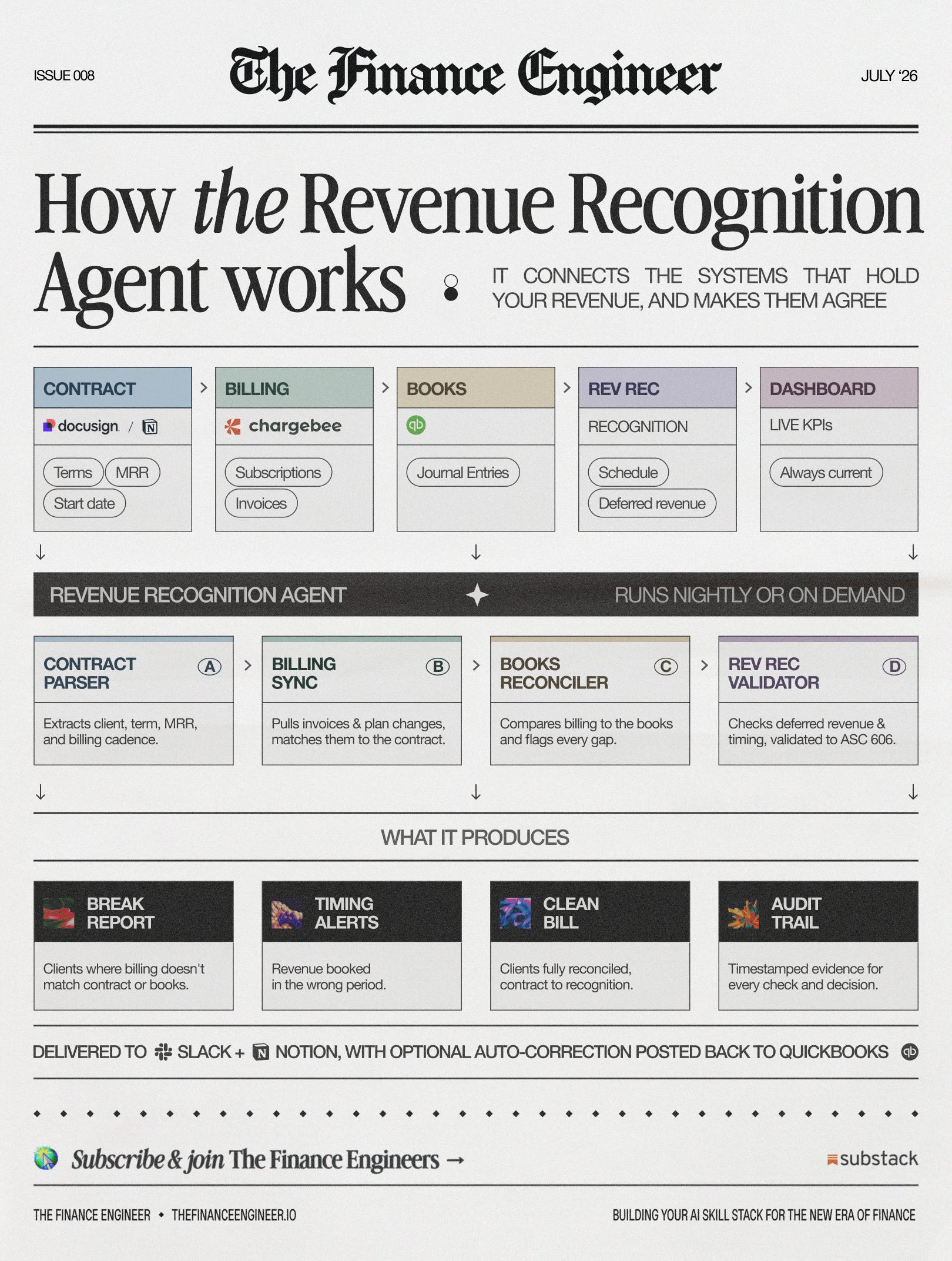
→ A. Contract Parser: extracts client, term, MRR, and billing cadence straight from the contract (DocuSign / Notion).
→ B. Billing Sync: pulls invoices and plan changes from Chargebee, matches them to the contract.
→ C. Books Reconciler: compares billing to what’s posted in QuickBooks, flags every gap.
→ D. Rev Rec Validator: checks deferred revenue and timing against ASC 606.
Notice the shape: each step compares two sources that should agree, and flags where they don’t. Contract vs billing. Billing vs books. Books vs recognition rules. That’s the whole trick. An agent like this isn’t magic - it’s your reconciliation ritual, written down, running nightly.
It produces four outputs: a Break Report (clients where billing ≠ contract or books), Timing Alerts (revenue booked in the wrong period), a Clean Bill (clients fully reconciled, contract to recognition), and an Audit Trail - timestamped evidence for every check.
Everything lands in Slack and Notion, with optional auto-correction posted back to QuickBooks.
The reconciliation that used to eat days of the close now runs in minutes.
Step one you can do today: write your rules down
The agent’s real superpower isn’t the automation. It’s that the rules exist explicitly at all. Before any of the plumbing, we had to answer five questions in writing - and answering them is valuable even if you never build anything:
1. What triggers recognition? Delivery, time elapsed, usage, milestones? Per product line, not “it depends.”
2. What’s the unit of recognition? Monthly ratable? Daily? On-invoice for one-offs?
3. What happens on a plan change? Upgrade mid-month, downgrade, cancellation, refund - each needs a written rule.
4. When is cash confirmed? Invoice sent ≠ paid. What’s your rule for revenue on unpaid invoices past X days?
5. What’s materiality? Below what threshold does a break get logged but not chased?
If your team can’t answer these in writing today, that’s not embarrassing - that’s the discovery.
Most rev rec policies live in someone’s head. This is how you get them out. And once they’re written down, you’ve done the hard part of building the agent: everything after this is plumbing.
This is what “finance manager → finance engineer” looks like
This agent wasn’t built by an engineer - it was built by Anneli, a finance person on our team who got curious.
Her rev rec judgment didn’t go anywhere. It got encoded, once, into something that runs while she does work that actually needs her.
Come watch it run, live
On July 9, Anneli and I are walking through this exact agent, live.
Real contracts, real Chargebee data, real QuickBooks, the messy parts included.
You’ll see the full pipeline (parser to validator to Break Report) and then 10-15 minutes of Q&A where you bring your own setup and we work through where your rev rec is leaking.
If rev rec is part of your close (or the part of your close you’ve learned not to look at directly) this is the one to be in the room for.
Save your seat → RSVP here.
Your homework before then: answer the five questions in writing, then pull one annual contract and trace it through - contract, billing, books.
What’s the part of rev rec you still decide by hand every month? That’s the one to encode first.
— Alyona