

Hey Finance Engineers,
Most of you know me as an ex-CFO who now builds finance software. Fewer of you know that I still run CFO office at my own company.
Which means that in spring, when AI started moving faster than anyone could keep up with (Anthropic had just shipped its financial services suite, on top of everything else), I had the same problem every CFO reading this has. I couldn’t ignore it anymore.
And I had to figure out how a team of experienced, careful, conservative finance people, shaped by years of stressful closes and processes buried in someone’s Excel files, was supposed to change.
I made 5 decisions. This issue is about those. If you’re a CFO or a finance leader wondering how to get your people to be AI-first, this is for you.
And one thing I didn’t see coming, which I’ll save for the end: when the CFO office starts this change, the rest of the company follows. It’s just a matter of time.
Let’s go.
What AI-native means
The term has gone mainstream, which means it has stopped meaning anything in particular.
So here is what I mean by it. AI-native finance has 4 pieces:
1. 90% of the manual work done by agents
2. One unified source of truth for the numbers
3. A human in the loop on every workflow
4. Accuracy measured on every run
Notice that none of those is a tool. You can’t buy your way into that list. You can only get there with a team that works differently.
Before you can have AI-native finance, you need an AI-native finance team.
Where your team is right now
Every finance team I’ve talked to this year is somewhere on the same path. Find yours before reading on, because the first move is different at each step.
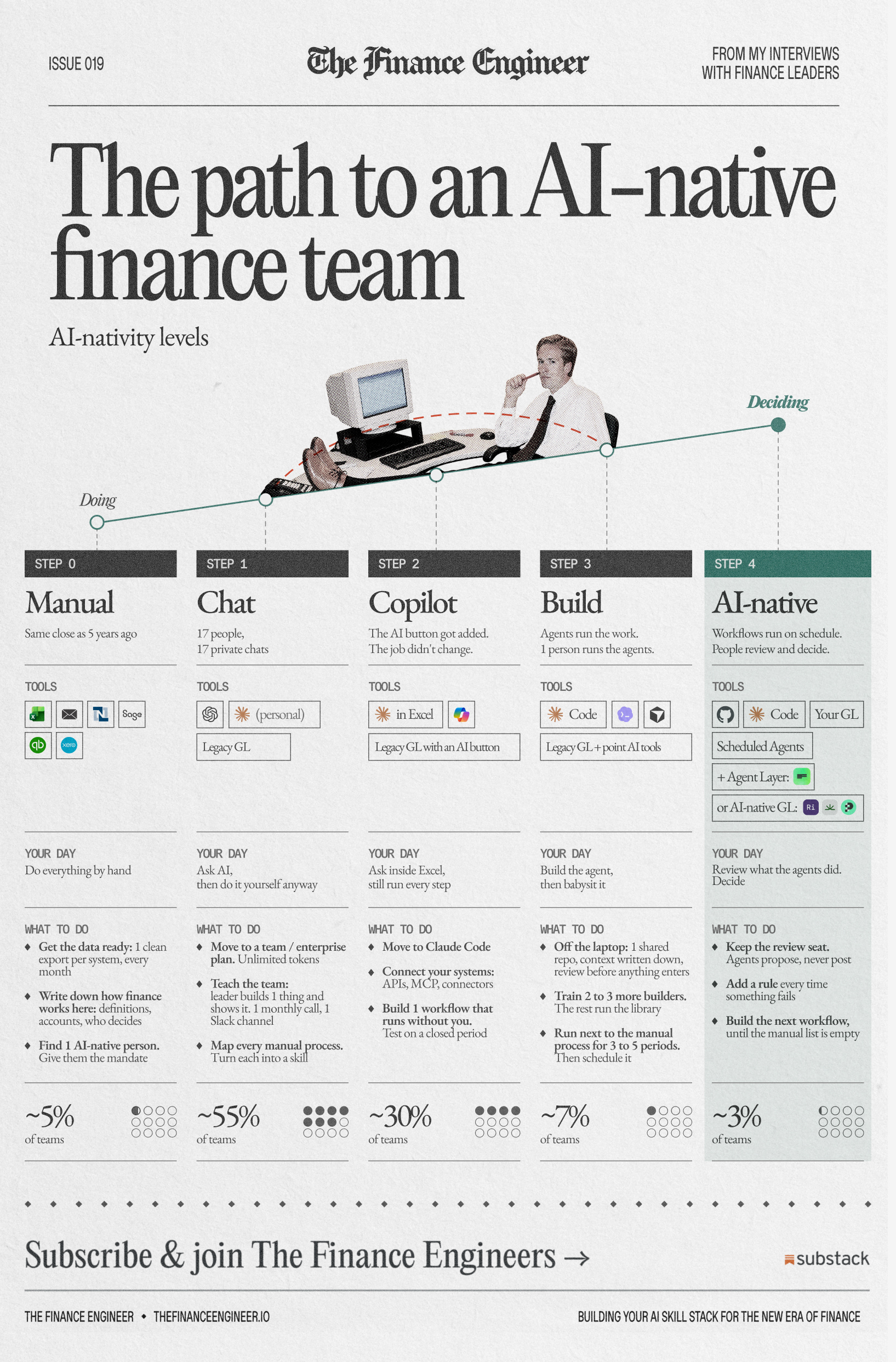
In March, my team was between step 1 and step 2, closer to 2. Everyone had a chat window open. Nothing was shared.
Today, 1/3 of my team are on step 4, and most of the rest are on step 3.
Here’s what happened in between.
1. I built something myself before asking anyone else to
If you lead the team, this change is your job. Not your deputy’s, not a working group’s, not the vendor’s. Yours.
I knew I couldn’t ask 17 people to change how they work until I’d changed how I work. So I built 3 things. A weekly sales report that pulls from HubSpot and lands in Slack every Monday morning. An outreach engine that finds leads, drafts the first message, and books the call. A forecasting playground where you change one assumption and watch the runway move.
Then I showed all 3 on a team call, with a step-by-step video of each build. A build log: here’s the prompt, here’s where it broke, here’s the fix, here’s where it broke again.
That call became a monthly ritual, and I opened a Slack channel for everything AI the same week.
Then I wrote a guide for my team on how to use Claude for finance work. The same guide that, when we made it public a few months later, got downloaded 10K+ times.
Looking back, this was the moment I became a finance engineer myself. Everything after it, including the newsletter you’re reading, started here.
2. I gave them the setup, the incentive, and permission to play
Once the team had seen it done, I removed every reason not to try.
We put everyone on Anthropic’s Enterprise plan, which is the safest option for your data, and told them there were no token limits.
The effect was faster than I expected. Within about a month, our Slack channel went from me posting links and screenshots to the whole team sharing what they’d built that day and arguing in the threads about how to make it better. I’ve led finance teams for a long time. I had never seen a finance team do that.
One caveat: it wasn’t tokenmaxxing. We never rewarded tokens spent. We never built a leaderboard. Spending is not progress.
What we rewarded was output. We set up bonuses for automated workflows, skills, agents, anything the whole team could use. If you’re asking people to build on top of their day jobs and then hand what they built to everyone else, you have to pay for that. It worked.
This is also the moment to audit your CFO office stack. Which tools are holding the team back? Which already have MCPs? Which subscriptions do you suddenly need that you never thought you would? GitHub, Vercel, that kind of thing.

And once your team starts building agents, how do you run them?
That’s what Fuel is for: a multi-agent platform for finance, with pre-built agents and your own, chained into workflows that take on 90% of the manual CFO office work while you stay in charge.
3. I brought engineering discipline into the CFO office
Here’s what happens when you give a finance team unlimited tokens and a bonus: almost everyone builds. And within weeks, it’s a mess.
By early summer we had dozens of skills and prompts spread across laptops, and no way for anyone to use what anyone else had built. So we went looking for a place to put them. It took 3 tries.
Notion first: prompts and files pasted into pages. Easy to start, impossible to maintain.
Then shared Claude projects, which were better, because the context came with the prompt.
Then GitHub, with a registry, review rules, and context files a second person could pick up cold. I walked you through that setup in the GitHub issue.
GitHub was the right answer, and it taught us something bigger than storage. A finance team that builds its own tools needs the same discipline an engineering team has. Versioning. An incubator. One person who owns the repo.
The rule we enforce from day 1: incubate before you standardize.
Every skill begins in someone’s personal folder. It moves into the shared library only after it has run on closed periods, been reviewed by a second person, and has context someone else could use.
Standardize too early and you kill the experiments. Standardize too late and you get 4 versions of the same AR check. We had 3. It was not fine.
4. I talked to every person about their career, one on one
A career in AI-native finance looks very different from a traditional one.
When an agent does the pre-close check in 2 hours instead of 2 to 3 days, the job changes, and for some people on my team that was frightening.
The fear slowed everything down, and underneath it was one question: “If I build this, do you still need me?”
You have to answer that question, with each person. The answer I gave was this: your job is no longer to do the work. Your job is to make the agent that does the work accurate. And the person who did that job by hand for 10 years is the only one who can.
That’s why every skill on my team runs first on a closed period, where we already know the right answer, and the person who used to do the work is the one who grades it. Nobody’s experience became obsolete. It became the test.
Of the whole team, 5 people chose to become what I call finance engineers. They build the agents and the automations.
The rest are the human in the loop: they decide what “correct” means, catch what the agent missed, and own the sign-off. That’s not the lesser role.
5. The change didn’t stay in finance
Once you run agents in the CFO office, you start noticing how many processes at the edges of other departments could be automated too. Finance touches everything. Every invoice, every hire, every contract, every plan passes through it.
The weekly sales report from decision 1 was a finance task, but sales reads it, and sales started asking for more. When our engineering lead saw what finance was building, he started posting his own agents in the same Slack channel, and the two teams began trading skills. The adoption chart that started as a finance thing is now a company thing.
So here is what I’d tell any CFO about to start: an AI-native finance function is not a finance project. It’s the first move in a company-wide one.
Finance is the department every other department depends on, which makes it the best place for the change to start, and the hardest place for it to stop.
It starts with the leader building something. Everything else follows.
One more thing
All of this went into our product. In September we launched the new Fuel: dozens of finance agents, chained into workflows for close, cash, forecast, and reporting, on top of the ledger you already have. My team built it. My team runs on it.
And sometimes even the CFO needs guidance. On request, Fuel is set up by one of our finance engineers, who builds your first workflows on your data and teaches your team to build the next ones.
This is a shortcut to both: AI-native team and AI-native finance department.
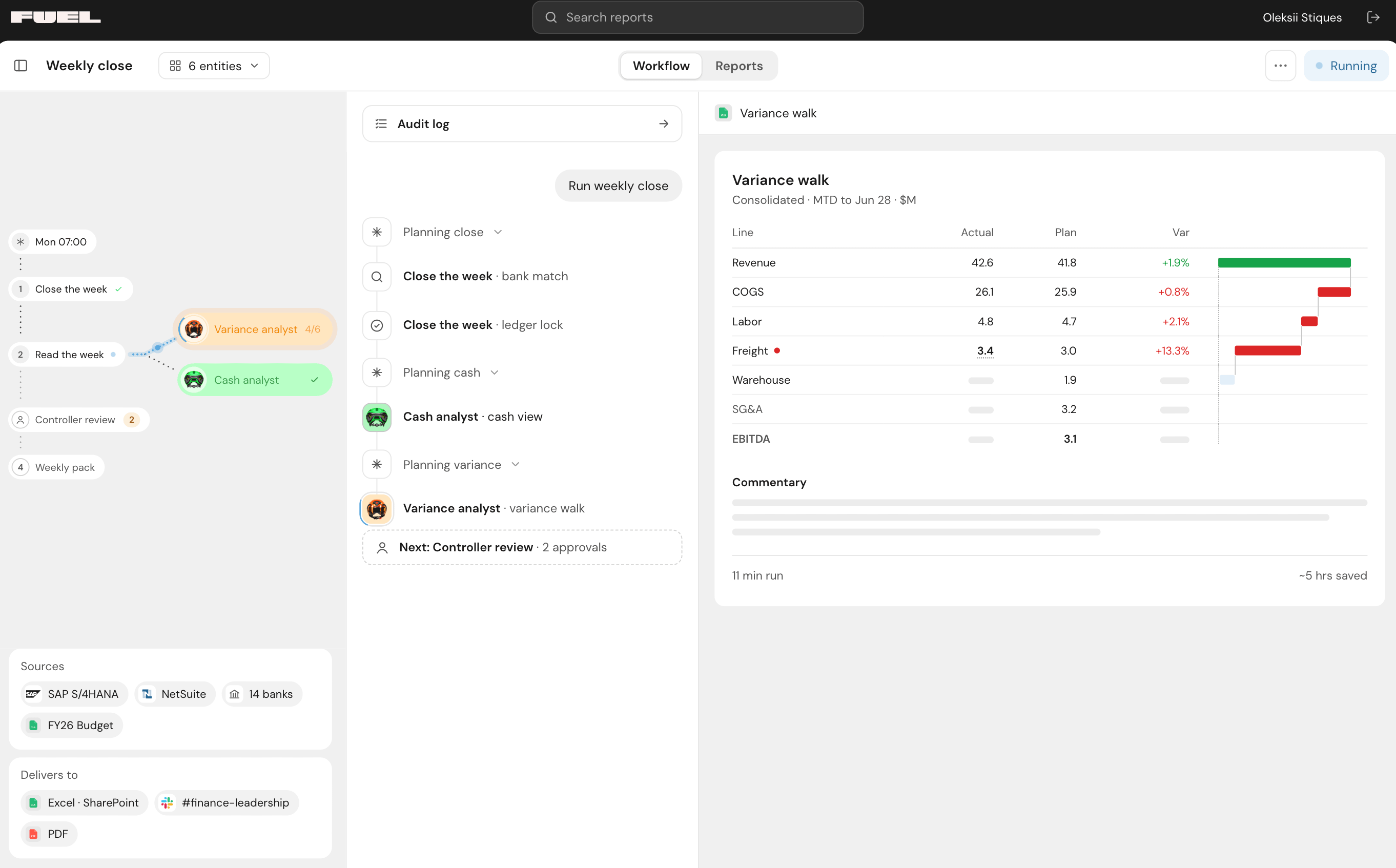
P.S. The launch live demo is recorded. Leaving it here.
Subscribe (and stay for the ride)
If you made it this far, you’re one of us. Subscribe for the weekly drop and these specials.
→ If you’re a vendor and you genuinely have something to offer this audience, fill in this form.
Let me know in comments what you think.
— Alyona
comprehensive and inspiring