total reading time: 8 minutes
About two thousand years ago, a Roman poet asked a question that finance teams are asking again today: Quis custodiet ipsos custodes? Who watches the watchmen?
(Juvenal wrote it as a joke about guarding wives. History turned it into one of the most quoted lines about power. Bring that to your next leadership offsite.)
Rome’s answer was not one perfect guard. It was a system of checks, including consuls who could veto each other and tribunes with the power to block decisions. Nobody’s power went unchecked.
The finance version of the question
So you’ve started setting up AI in your finance team. Maybe you already have 10 or 15 agents on different tasks. Maybe some of them already run as workflows, and agents are now a part of your monthly close. Or maybe you’re just getting started, like most finance teams: only about one in ten runs agents today.
Either way, you’ll hit the same wall. Agents save hours, but then every morning, someone on your team opens the numbers and checks them by hand anyway.
Agents may fail, yes. But the issue is, you can’t tell when they do. A wrong number looks exactly like a right one, and a job that never ran looks exactly like one that did. So you don’t trust them. And without trust, the hours you saved go straight back into re-checking.
What you’re missing is a trust layer.
At my own CFO office at Fuel, we hit this problem once we had more agents than people could check.
Our answer was the same as Rome’s: checks, not trust. Every agent first ran on a closed period where we already knew the right answer, and the person who used to do that work by hand graded it. We boiled the daily checking down to four questions you need to ask about every agent before you can trust it.
The four questions of the trust layer
Did it run? Every agent should start on schedule and finish. A skipped run looks exactly like a quiet one.
Is the data fresh? An agent can report “success” while the dashboard still shows yesterday’s numbers.
Are the numbers right? Key figures should tie back to the original source, not to the agent’s own math.
Is anything unwatched? A new agent nobody registered, or a day when no checks ran at all, can look exactly like a clean morning.
That’s when we realized we don’t need a person to ask these four questions every morning. An agent can do it, faster and on every number instead of a sample. We call it the Watchman.
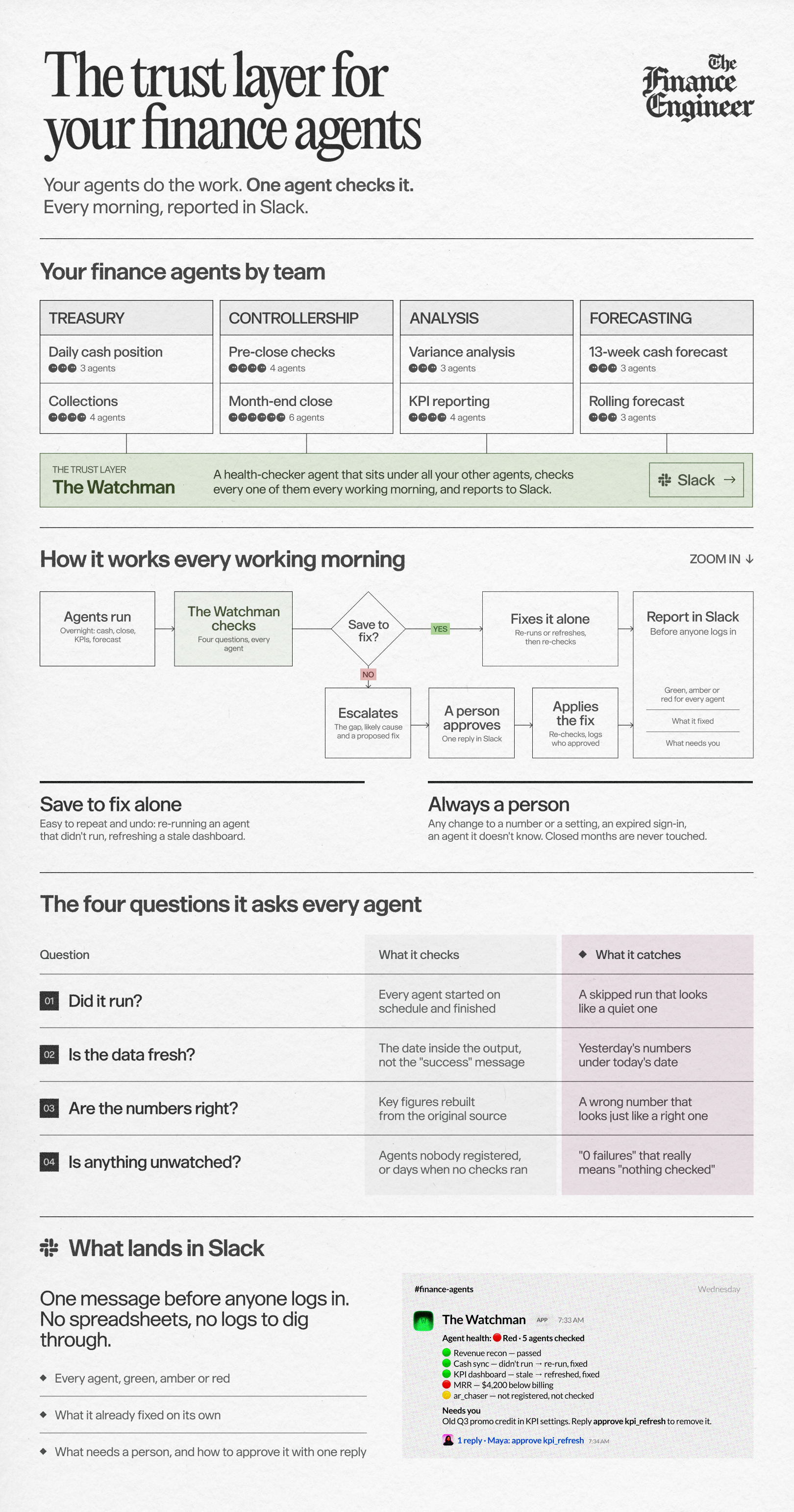
The Watchman works like a bot in Slack. Every working morning, after your other agents finish, it asks the four questions about each one, fixes what’s safe to fix on its own, and sends you one report: green, amber or red for every agent, what it already fixed, and what needs a person. Anything that would change a number waits for your approval.
If you already run agents, this is the layer you’re missing. If you’re just starting, build this layer along with your agents.
If you jump over the paywall, here’s what you’ll find:
The step-by-step plan to build your own Watchman agent;
Five failures to plant, so you can watch it catch them before you trust it;
The full kit: the build guide, a registry template, and a run-log example.
You’ll get all of that and more if you support this publication.
And in the meantime, if you want to go deeper into how to build agentic workflows, I’d love for you to join the live session I’m running at Fuel, the company I founded and where I still run the CFO office.
On Thursday, Dec 3, at 10:00 AM ET, I’ll turn one manual finance process into an agentic workflow in 45 minutes, trust layer included.